Appreciating Tony Leggett (1938-2026)
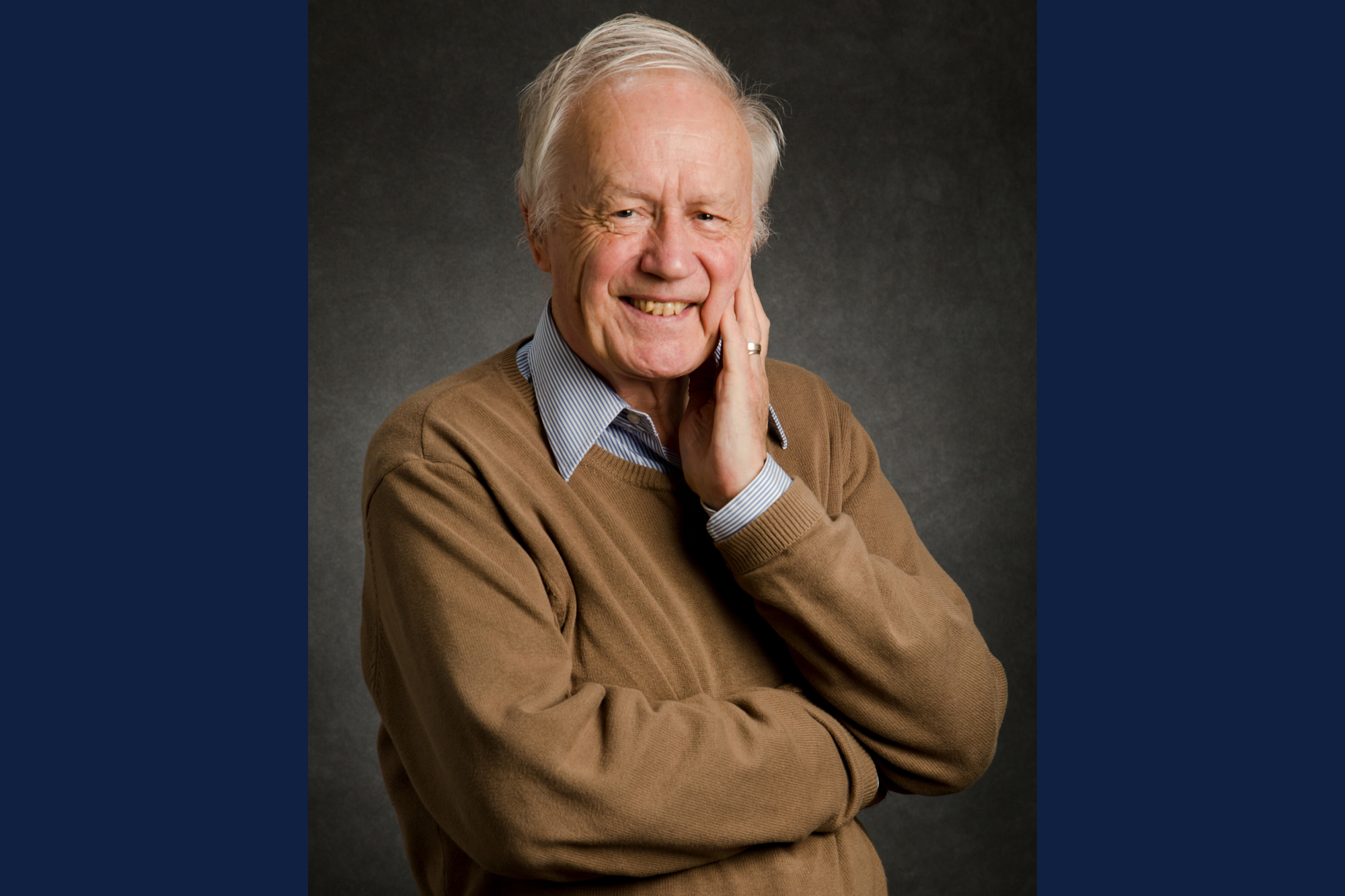
Sir Anthony James Leggett. Photo by L. Brian Stauffer
Sir Anthony James Leggett, Nobel laureate and longtime professor of condensed matter physics at U. Illinois, passed away a few days ago. I’m sure we will hear from others who are much more qualified to directly speak about Tony’s work and legacy. Here I instead offer a view from the relative sidelines, which might by its distance say something of the size of his contributions to fields of quantum physics.
The plural “fields” is key here. To the extent that my own career across various quantum playgrounds makes any coherent sense at all, it is in large part because of the connections that Tony forged. That same quality also makes his work difficult to summarize. His Nobel citation was “for pioneering contributions to the theory of superconductors and superfluids”, which is generally understood to be the theory of liquid Helium-3 that he developed. Important as that work may be, this is one case where the Nobel citation for a scientist should not be understood to summarize their overall contribution. Indeed, while I have learned a lot from Tony, I have to admit that I’ve never studied liquid Helium nor read any of his papers on the subject. I once heard Tony refer to the significance of his work in liquid He-3 as being that it provided an almost unique example of a comprehensive description of a strongly interacting quantum system. That takes us closer to the significance of his work, but maybe still doesn’t fully capture it (a reflection, perhaps, of his characteristic modesty and care in not overstating his case). My attempt to summarize Tony’s most important contribution would be that he clarified how macroscopic quantum coherence appears in a variety of settings, which may look superficially very different. In addition to liquid Helium, those settings include several of my favorite experimental platforms.
For example, my PhD work studied the physics of collections of ultracold dilute atoms, suspended in a vacuum chamber. The context for this was the breakthrough (which won a different Nobel prize) in trapping and cooling techniques that let us create a sample of these atoms that is colder than anything else we know of, billionths of a degree above absolute zero. At these temperatures, the individual quantum wavefunctions of the atoms strongly overlap and influence the material properties. This allows for exotic effects such as Bose-Einstein condensation, in which an entire cloud of atoms behaves as a single quantum wave. Although this experimental development came relatively late in Tony’s career, he became very interested in it, and played an important role in developing the theoretical understanding of these ultracold atomic gases 1. He especially helped to develop our understanding of the “BEC-BCS crossover”, which describes how a Bose-Einstein Condensate (BEC) of strongly bound atoms or molecules and a superconductor of weakly bound pairs can be understood as two extremes along a smooth continuum. This work gave us a simple yet precise theoretical framework to understand how these effects were connected—emblematic, in my mind, of Tony’s style.
More recently, I’ve been involved in the attempt to build a quantum computer out of superconducting circuits. This is a totally different experimental system, at least superficially—I have swapped atoms floating in vacuum chambers, shimmering under the glow of lasers, for electronic circuits at the bottom of a cryogenic chandelier of wires. Nonetheless, here too I follow a path whose theoretical waypoints were laid by Tony. The 2025 Nobel prize recognized some of the key experimental work that showed that quantum coherence could be observed and controlled on a large scale in electronic circuits (under special conditions, such as very cold temperatures and isolation from their surroundings). This large-scale controllable coherence is precisely what allows us to use these circuits as the building blocks for a quantum computer. As the laureates of this prize tell it, Tony was a key influence in the pursuit of these effects. Indeed, his is the first citation in the Nobel committee’s technical explanation of the prize.
Tony’s point of view on how these effects should be understood in a unified way is best developed in his textbook, Quantum Liquids. It is a fantastic and idiosyncratic work (and, unlike much of Tony’s writing, it is technically at about the advanced undergraduate level). The term “quantum liquids,” which is not in very common usage 2, allows Tony to talk at once about a whole set of superficially different systems. He uses it to describe how physical systems such as superconducting metals, liquid Helium, and ultracold atomic gases all can be viewed as variations on a theme. Thanks to him, in my own random walk through studying these systems I have been able to work from a general understanding, rather than trying to approach each one in isolation.
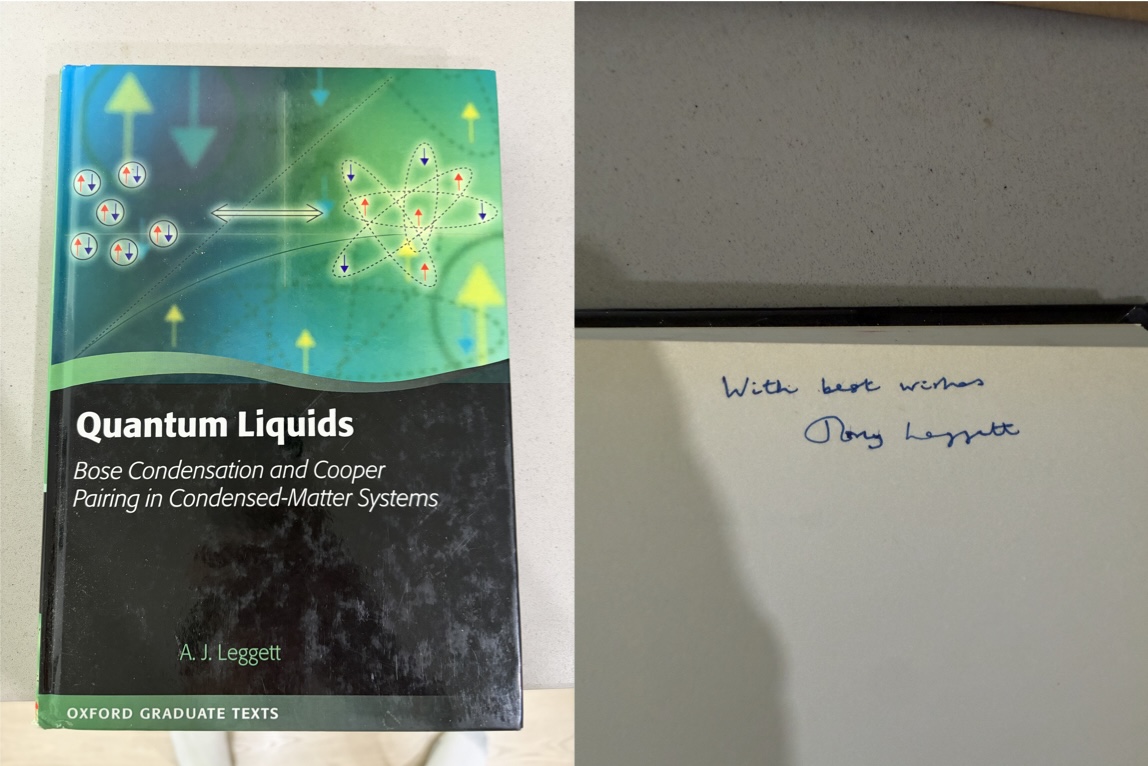
The author’s prized, signed copy of Quantum Liquids. The cover is an artistic depiction of the BEC-BCS crossover.
Beyond his specific contributions, I also found Tony’s style of thinking through a physics problem very inspiring. I got to see this repeatedly during my time at Illinois, but especially when I took his special seminar on superconductivity. One can look through the lecture notes for the course to get a feeling for it. His explanations were always extremely economic and terse, and relied heavily on physical intuition and arguments based on dimensionality and energy scales to get at the shape of a problem. At the same time, once he had the lay of the land he would analyze it extremely thoroughly and carefully, often worrying about assumptions that others would take as given 3. All of these traits are not uncommon among good physicists, but in Tony this way of reasoning was sharpened to a surgical precision.
I will leave stories of Tony’s personality to others who knew him better, but I always found him to be utterly without pretension or bombast, which is a notable quality in theoretical condensed matter physics. He was also a great supporter of the physics department at Illinois. That is how I came to have a signed copy of Quantum Liquids. He donated it to the Physics Grad Student Association for an auction, and luckily for me no one beat my shaky grad student bid (probably because most of the other people there were also grad students).
Farewell, Tony. We will be reading your papers for many years to come.
see, e.g., https://journals.aps.org/rmp/abstract/10.1103/RevModPhys.73.307 ↩︎
As far as I know, it was previously used mainly in the excellent textbook co-authored by Leggett’s predecessor and colleague at Illinois, David Pines ↩︎
Like, say, whether a BEC should really be described by a quantum wave with a constant phase, since this turns out to imply that is has an indeterminate number of particles ↩︎